

Spring: Jan 29 – Jun 19, 2027
Fall: Late Aug – Mid Dec, 2027
Kinesiology & Sport Science, Law & Legal Studies, Mathematics & Statistics, Computer Science, Health Sciences & Medicine, Education, Cybersecurity, Artificial Intelligence, Sustainability & Environmental Policy, Humanities & Social Sciences, Business & Economics
starting at
$--
Let's hop to it!


the rundown
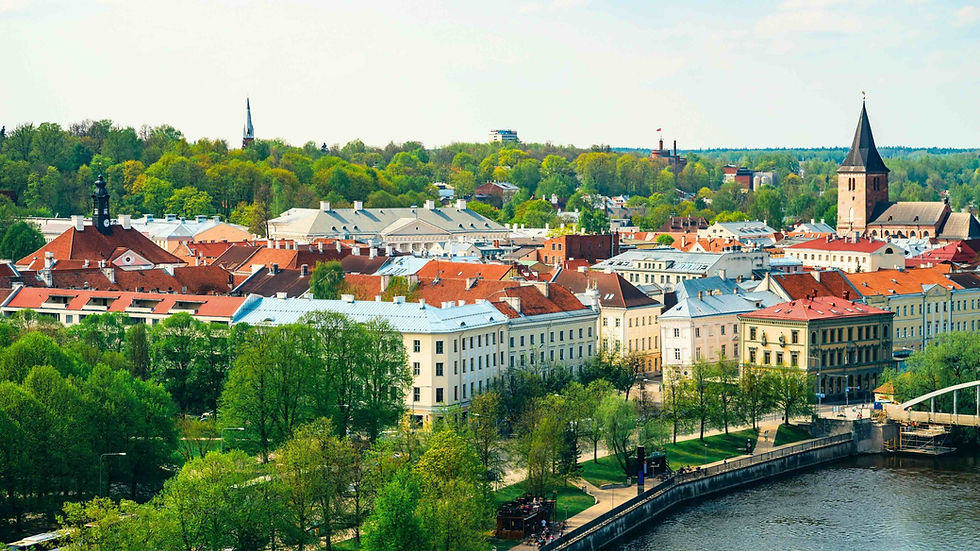
You’re living in one of Europe’s oldest university towns, where half the people you pass on the street are students and the rest are probably teaching them. Your walk to class might take you along the Emajõgi River or through a cobblestone square with medieval architecture. Tartu is known as the City of Youth: compact, creative, curious, and always buzzing with student life. On any given week you might end up at a bog hike, an international food night, or an underground DJ. With free public Wi-Fi across town and a government that votes online, you’re in the middle of one of the most digitally advanced societies in the world, but one that’s deeply proud of its forests, folklore, and language.


your academic journey
The University of Tartu is Estonia’s top-ranked university and the academic heartbeat of the country. Known for strong programs in computer science, information technology, humanities, social sciences, and regional studies, it offers an expanding range of English-taught semester and summer courses. Whether you’re digging into media theory, international relations, digital governance, or Arctic geopolitics, Tartu provides a Baltic lens on global issues plus it’s also a digital innovator. Estonia’s rise as an e-society means students are part of a tech-forward environment where nearly everything, from class registration to civic services, is online and seamless.
Founded in 1632, the University of Tartu is one of the oldest universities in Northern Europe and Estonia’s most prestigious. A member of multiple global research networks, the university blends historical tradition with a spirit of innovation that defines the modern Estonian identity. Its location in the center of Tartu gives it the feeling of a walkable college town, where you’re never far from a lecture hall, a cozy study café, or a student-run theater. Tartu is also home to several other academic institutions so the town lives and breathes university life, making it easy to plug in, find your people, and get involved.
Hundreds of courses are taught in English across a wide range of disciplines, with small class sizes that encourage dialogue, debate, and cross-cultural learning. Whether you’re diving into global politics or digital governance, you’ll find space here to think critically and create freely and you’ll be learning in lecture halls that have hosted Nobel Prize winners, presidents, and pioneering thinkers.
Key areas of study include:
Political Science and International Relations
Digital Society and Cybersecurity
Health Sciences and Neuroscience
European Languages and Cultures
Artificial Intelligence and Robotics
Semiotics and Cultural Studies
Human Molecular and Clinical Genetics
Health SciencesCOURSE CODE
ARMP.01.026
The course provides basic knowledge in human and medical genetics and an overview of the clinical genetics field. The course covers genetics of monogenic and chromosomal diseases; developmental genetics; genetics of multifactorial diseases and cancer; broader role and special features of genetics in medicine; molecular diagnostics and screening programmes of genetic diseases, basis of gene therapy; state-of-the art overview of the clinical genetics applications and interactions with other medical disciplines.TERM
Spring
CREDIT
6 ECTS
Human Physiology
COURSE CODE
ARFS.01.030
The goal of a present course is to study the basic functions of human body - from the molecular level to the level of whole organism. A special attention is paid to the teaching of physiological role of sensory and central nervous system.TERM
Fall
CREDIT
12 ECTS
Human Resource Management and Organization Behaviour
ManagementCOURSE CODE
MJJV.03.147
The subject involves personnel management and organizational behaviour. Its aim is to analyse the link between the functioning of an organization and the human behaviour. The problems connected with the study of bearing are handled from the point of view of the person filling the role of an executive. Under the observation are the questions about formulating and harnessing the staff and also the theoretical and practical problems of the employees behaviour.TERM
Spring
CREDIT
6 ECTS
Human Rights and Information Technology
Law & Legal StudiesCOURSE CODE
OIAO.05.074
* We live in a digital era and this requires adapting the legal system for the cyber 'realm'. * The students should understand how the Internet works, who plays which role in Internet ecosystem, how it influences human rights, what challenges exist for the rule of law online. * The course focuses on teaching how to use the European Convention for the Protection of Human Rights and Fundamental Freedoms (ECHR), other international legal instruments and case law of the European Court of Human Rights (ECtHR) in daily practice in cases related to Internet usage; it focuses on developing skills of identifying human rights in legal cases; and on interpreting and evaluating the national legal rules with regard to Internet; Structure: o Introduction to Internet eco-system o Human Rights online o Access and non-discrimination o Freedom of expression and information o Assembly, association and participation o Privacy and data protection o Effective remedies * The structure will be adapted pursuant to the level of knowledge of participants.TERM
Fall
CREDIT
3 ECTS
Humour Theories and Their Applications
Anthropology PsychologyCOURSE CODE
FLKU.04.142
Through theoretical lectures, literature review and small practical tasks, the following topics will be covered: 1. Humour theory and respective definitions. 2. Humour research (incl old folk jokes, punchlined jokes, internet humour), new directions in humour research. Basic literature (additional articles will be referred to prior to particular lectures or in the course of them in order to enhance the understanding of the topic): + Martin, Rod (2007). Introduction to the Psychology of Humor (Chapter 1). The Psychology of Humor: An Integrative Approach. Burlington: Elsevier Academic Press, pp. 1-30. + Oring, Elliott (2008). Humour in Anthropology and Folklore. In: Raskin, V. (Ed). The Primer of Humor Research. Berlin: Mouton de Gruyter, pp. 183-210 + Krikmann, A. (2003). Puändita naljandite struktuurist. Keel ja Kirjandus, 3, pp. 161-177; (in English: http://www.folklore.ee/~kriku/HUUMOR/KRIKMANN_ATU_ready.pdf) + Brodie, I. (2015). Stand-up comedy and a folkloristic approach. In A vulgar art: A new approach to stand-up comedy. Jackson: University Press of Mississippi, pp. 11-42 + Boxman-Shabtai, Lillian & Shifman, Limor (2016). Digital Humor and the Articulation of Locality in an Age of Global Flows. HUMOR, Vol 29, No 1, pp. 1-24 + Davis, Jessica Milner (2016). Satire and its constraints: Case studies from Australia, Japan, and the People's Republic of China, HUMOR Vol 29, No 2, pp. 197-222TERM
Spring
CREDIT
3 ECTS
Hungarian Course on the Basis of English for Beginners
COURSE CODE
FLEE.06.179
A course for international students aimed at providing basic knowledge of grammar and practising oral skills.TERM
Fall
CREDIT
12 ECTS
To be eligible for a Hop Education Abroad program, students must be currently enrolled at a degree-granting college or university, have completed at least one year of their undergraduate studies prior to departure, and be in good academic standing at their home institution.
We do not have a set GPA requirement to participate in our programs—we believe in making global experiences as accessible as possible. However, some of our international university partners or your home institution may set their own academic eligibility criteria.
University of Tartu requires good academic standing and approval from your home institution. There is no minimum GPA.
The course listings provided in our Course Finder are for informational purposes only and are subject to change. Our global partners keep things exciting—course offerings may change anytime! We do our best to stay up to date, but check with us to be sure. Got questions? Hop in and ask!
Human Molecular and Clinical Genetics
COURSE CODE
ARMP.01.026
CREDIT
6 ECTS
TERM
Spring
Human Physiology
COURSE CODE
ARFS.01.030
CREDIT
12 ECTS
TERM
Fall
Human Resource Management and Organization Behaviour
COURSE CODE
MJJV.03.147
CREDIT
6 ECTS
TERM
Spring
Human Rights and Information Technology
COURSE CODE
OIAO.05.074
CREDIT
3 ECTS
TERM
Fall
Humour Theories and Their Applications
COURSE CODE
FLKU.04.142
CREDIT
3 ECTS
TERM
Spring
Hungarian Course on the Basis of English for Beginners
COURSE CODE
FLEE.06.179
CREDIT
12 ECTS
TERM
Fall
- Page 56
Filter items with Program
- Filter items with Term
Showing X courses
explore University of Tartu courses
No course results. Try another search term.

your abode
You will be living in Raatuse 22 residence hall within walking distance of the main university buildings and city center. Rooms are twins with shared bathroom and kitchen spaces (usually 2–3 rooms per shared unit). Rooms are furnished and include bedding; Hop provides some basic cookware, and you’ll often be gifted a saucepan or two from the previous resident. Halls are secure, social, and student-run at heart—with laundry access, Wi-Fi, and easy access to public transit. Whether you’re meal prepping with your flatmates or heading out for late-night pelmeenid (Estonian dumplings), you’re living right in the mix of student life.

local vibes
Tartu is Estonia’s second-largest city, but its spirit is young, walkable, and wired. It’s small enough to feel personal, but full of life—especially when the semester is in full swing. Expect international film nights, student theatre shows, spring and autumn student festivals, and weekends hiking through boglands or sweating it out in traditional saunas. Cafés double as study spaces, bookstores host poetry nights, and academic debates spill over into bar conversations. Tartu feels like one big open-air campus, and if you want to go deeper into the Baltics, Finland or Latvia are just a short trip away.

Find balance and clarity through guided yoga and meditation at a Austrian resort.

Lace up your snowshoes and experience the magic of the Alps on a breathtaking alpine hike.

Nourish your body with hearty alpine meals shared in a cozy mountain setting.

Arrive grounded, inspired, and ready to embrace your journey in Europe with clarity, connection, and a renewed sense of self.


Mayrhofen, Austria
The Hop Well-Come Abroad:
a mindful start to your semester
The exclusive Hop Well-Come Abroad program in Mayrhofen sets the tone for an uplifting and balanced start to your time in Europe. Nestled in the Austrian Alps, this active program blends fresh mountain air with a focus on mental and physical well-being. Each session equips you with the confidence and resilience needed to settle into your new home while embracing alpine traditions and cultural moments. Expect panoramic hikes, cozy mountain huts, hearty Tyrolean meals, and plenty of laughter—all surrounded by breathtaking alpine scenery.
Rome
Tour the Colosseum, indulge in authentic Italian gelato, and explore the vast riches of the Vatican Museums. Rome wasn’t built in a day but see it all in a Hop weekend.

EXPERIENCE MORE OF
Europe
Tartu is just the start. Explore Europe through excursions and cultural experiences, with one weekend excursion of your choosing included with your Hop study abroad program.
Prague
Chase castle views, cobblestone streets, and storybook sunsets on your Hop weekend getaway to the fairytale city of Prague.

Bean
University of Tulsa
"I am so glad I found Hop. [The team has] been so kind and accommodating, really making this semester a beautiful and adventurous time. I wish Hop had more programs that would fit my goals because I would choose Hop for all of them if I could."


making it happen
Tartu, Estonia
Spring: Jan 29 – Jun 19, 2027
Fall: Late Aug – Mid Dec, 2027
starting at
$XXXXX
inclusions
Semester Tuition
Shared student housing in University of Tartu dormitories
Your choice of Rome or Prague weekend escapes
The Hop Well-come in Mayrhofen, Austria (and travel to Tartu)
Airport reception and pickup (from Tallinn or Tartu, depending on arrival)
Health and Travel Insurance
24/7 Hop support and your Hop Go-To (other programs say Resident Director)
Pre-departure advising to get you ready
International airfare not included


why study abroad with Hop?
Because we do study abroad differently. We’re all about creating a community that’s as diverse, adventurous, and curious as you are. Our programs are anything but cookie-cutter.
unique & innovative experiences
Our programs offers one-of-a-kind experiences tailored to various interests—whether you're diving into Korean culture in Seoul, competing on Scholar Island in Fiji, exploring the world Down Under in Australia, experiencing the beating heart of Europe, or innovating with startups in Thailand.
a focus on you
Studying abroad is all about you—and we’re here to make sure you feel supported every step of the way. From our mindfulness-focused Well-Come Abroad orientation program to our dedicated on-the-ground support staff, we ensure you gain invaluable international experience, develop new skills, and boost your resume—all while having the time of your life and prioritizing your health and well-being.
global connections
Join a community of like-minded peers from around the world while building relationships with locals, professionals, and professors who can inspire your academic and career journey.
why study abroad with Hop this summer?
Summer with Hop isn’t just about academics—it’s about creating unforgettable memories, challenging yourself, and returning home with stories that will stay with you forever.
unique & innovative experiences
Our programs offers one-of-a-kind summer experiences tailored to various interests—whether you're diving into Korean culture in Seoul, competing on Scholar Island in Fiji, experiencing the beating heart of Europe, or innovating with startups in Thailand.
short yet impactful
Summer is the perfect time for a focused, immersive program. In just a few weeks, you can gain international experience, learn new skills, and build your resume without interrupting your academic year.
global connections
Join a community of like-minded peers from around the world while building relationships with locals, professionals, and professors who can inspire your academic and career journey.


We acknowledge the Traditional Owners of the lands upon which our students are welcomed, recognizing that our experiences are held on their ancestral territories. We deeply respect and honor the enduring cultures and significant contributions of all First Peoples, past, present, and emerging.