

Spring: Jan 29 – Jun 19, 2027
Fall: Late Aug – Mid Dec, 2027
Kinesiology & Sport Science, Law & Legal Studies, Mathematics & Statistics, Computer Science, Health Sciences & Medicine, Education, Cybersecurity, Artificial Intelligence, Sustainability & Environmental Policy, Humanities & Social Sciences, Business & Economics
starting at
$--
Let's hop to it!


the rundown
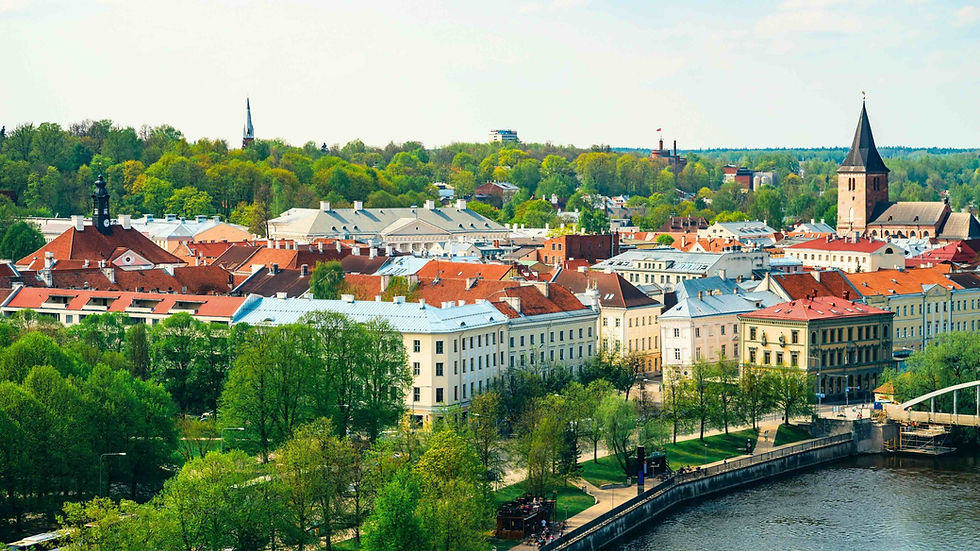
You’re living in one of Europe’s oldest university towns, where half the people you pass on the street are students and the rest are probably teaching them. Your walk to class might take you along the Emajõgi River or through a cobblestone square with medieval architecture. Tartu is known as the City of Youth: compact, creative, curious, and always buzzing with student life. On any given week you might end up at a bog hike, an international food night, or an underground DJ. With free public Wi-Fi across town and a government that votes online, you’re in the middle of one of the most digitally advanced societies in the world, but one that’s deeply proud of its forests, folklore, and language.


your academic journey
The University of Tartu is Estonia’s top-ranked university and the academic heartbeat of the country. Known for strong programs in computer science, information technology, humanities, social sciences, and regional studies, it offers an expanding range of English-taught semester and summer courses. Whether you’re digging into media theory, international relations, digital governance, or Arctic geopolitics, Tartu provides a Baltic lens on global issues plus it’s also a digital innovator. Estonia’s rise as an e-society means students are part of a tech-forward environment where nearly everything, from class registration to civic services, is online and seamless.
Founded in 1632, the University of Tartu is one of the oldest universities in Northern Europe and Estonia’s most prestigious. A member of multiple global research networks, the university blends historical tradition with a spirit of innovation that defines the modern Estonian identity. Its location in the center of Tartu gives it the feeling of a walkable college town, where you’re never far from a lecture hall, a cozy study café, or a student-run theater. Tartu is also home to several other academic institutions so the town lives and breathes university life, making it easy to plug in, find your people, and get involved.
Hundreds of courses are taught in English across a wide range of disciplines, with small class sizes that encourage dialogue, debate, and cross-cultural learning. Whether you’re diving into global politics or digital governance, you’ll find space here to think critically and create freely and you’ll be learning in lecture halls that have hosted Nobel Prize winners, presidents, and pioneering thinkers.
Key areas of study include:
Political Science and International Relations
Digital Society and Cybersecurity
Health Sciences and Neuroscience
European Languages and Cultures
Artificial Intelligence and Robotics
Semiotics and Cultural Studies
Foreign Policy Analysis
Political ScienceCOURSE CODE
SORG.04.011
This course will combine factor-based and model-based approaches to examine the contemporary literature that comprises Foreign Policy Analysis (FPA) as a seminal sub-field in International Relations. Foreign policy is ubiquitous with international politics as it is the most commonly recognized mode of state agency. Foreign policy is driven and constrained by a wide variety of "international", "transnational" and "domestic" variables. To provide structured examination of the influence that the most pertinent variables in these categories have on the foreign policy decision-making process, this course is divided into two different sections. Section I will examine the principal factors that regularly affect the foreign policy decision-making process. This includes assessment of the external, domestic, formal institutional, transnational and ideational factors that shape foreign policy. Part II will examine the strengths and weaknesses of the main models proposed to explain the main decision-dynamics involved in the foreign policy formation process, this will include assessment of the rational-actor model; the governmental politics model; the leadership trait approach; the operational code approach; prospect theory; poliheuristic theory; analogical reasoning; and groupthink.TERM
Spring
CREDIT
6 ECTS
Forensic Medicine
Health SciencesCOURSE CODE
ARPA.02.012
During the course students get an overview of the nature and causes of death, injuries and their causing mechanisms, nature and causes of health damage, possibilities of laboratory investigations in solving juridical problems. Attention is paid to the importance of describing injuries and its role in determing mechanism and time of injuries and to the juridical aspects of filling in medical documentation.TERM
Spring
CREDIT
2 ECTS
Frege Lectures
Philosophy & EthicsCOURSE CODE
FLFI.04.101
Seminars are held in preparation for Gottlob Frege lectures in theoretical philosophy, where relevant texts provided by the lecturer are discussed. Participation in preparatory seminars, Frege lectures, and the related workshop (if offered that year) is required.TERM
Fall
CREDIT
3 ECTS
French for Beginners I (on the Basis of English), Level 0 > A1.1
Communication & Media French Language & CultureCOURSE CODE
HVLC.03.006
The course presupposes no preliminary knowledge of French. The contents of the course as communication situations and vocabulary related: - presenting oneself and others (name, nationality, profession); - identifying or introducing persons and objects (Who is this? What is this?); - expressions of courtesy (greetings, apologies, etc.); - introducing oneself, personal data (name, age, address, profession, marital status, etc.); - work and studies; - leisure activities, sports, preferences; - hometown, living quarters; - dates, time, schedule; - making, accepting or refusing a proposition; - EU and other countries. Grammar topics: - introduction to the grammar terminology; - pronunciation rules; - numbers; - verb conjugation (present tense, indicative mood); - article (definite, indefinite, contracted); - nouns and adjectives (gender and number); - prepositions "de" and "à"; - prepositions before countries' names and other place names; - negative sentence; - interrogative sentence, interrogative words; - possessive adjectives; - personal pronouns (subject pronouns and stressed pronouns); - immediate future (futur proche); - affirmative answer "si" to the negative question.TERM
Fall
CREDIT
6 ECTS
French for Beginners II (on the Basis of English), Level A1.1 > A1.2
Communication & Media French Language & CultureCOURSE CODE
HVLC.03.008
The course presupposes the Council of Europe Level A.1.1. The contents of the course as communication situations and vocabulary related: - talking about timetables, telling/asking the time; - making an appointment; - lodgings, booking a room; - directions, describing views and places; - expressing possession, describing one's belongings; - giving orders; - talking about everyday activities, today and yesterday, communicating past events; - describing a person, his/her appearances, clothing, fashion; - describing different objects (their form, colour, material), choosing a gift, shopping; - food, different food-stores, meals, ordering in a cafe/a restaurant. Grammar topics: - continuous verbe practice, general survey of the tenses of the indicative mood; - interrogative sentence, questions with subject/verb inversion; - demonstrative determiners, expressing possession (possessives + preposition à); - pronominal verbs; - imperative mood, expression of obligation (il faut + infinitive); - the past tense passé composé; - impersonal pronouns (quelque chose, quelqu'un ) + negation: alternate forms (rien, personne); - determiners: expressions of quantity, partitive articles.TERM
Spring
CREDIT
6 ECTS
French for Beginners III (on the Basis of English), Level A1.2 > A2.1
French Language & Culture Languages & LinguisticsCOURSE CODE
HVLC.03.009
The course presupposes the Council of Europe Level A1.2. The contents of the course (communication situations and vocabulary): - learning and studies; - expressing opinion, emotions, motivation and preferences; - accommodation (types and description); - comparison; - everyday activities; - giving advice and asking for one; - describing the past (memories, habits), telling a biography or stories in the past, talking about one's experiences. Grammar topics: - revision of verb conjugation (indicative mood, present tense); - revision of personal pronouns as direct (pronom personnel complément d'objet direct, COD) and indirect objects (pronom personnel complément d'objet indirect, COI); - pronoun of place Y and spatial prepositions; - comparatives and superlatives; - causal conjunctions; - relative pronouns (qui, que, où); - indefinite adjectives and pronouns; - the past tenses imparfait and passé composé and choosing between them when telling a story in the past; - passé composé: agreement of the past participle in gender and in number; - present continuous présent continu.TERM
Fall
CREDIT
6 ECTS
To be eligible for a Hop Education Abroad program, students must be currently enrolled at a degree-granting college or university, have completed at least one year of their undergraduate studies prior to departure, and be in good academic standing at their home institution.
We do not have a set GPA requirement to participate in our programs—we believe in making global experiences as accessible as possible. However, some of our international university partners or your home institution may set their own academic eligibility criteria.
University of Tartu requires good academic standing and approval from your home institution. There is no minimum GPA.
The course listings provided in our Course Finder are for informational purposes only and are subject to change. Our global partners keep things exciting—course offerings may change anytime! We do our best to stay up to date, but check with us to be sure. Got questions? Hop in and ask!
Foreign Policy Analysis
COURSE CODE
SORG.04.011
CREDIT
6 ECTS
TERM
Spring
Forensic Medicine
COURSE CODE
ARPA.02.012
CREDIT
2 ECTS
TERM
Spring
Frege Lectures
COURSE CODE
FLFI.04.101
CREDIT
3 ECTS
TERM
Fall
French for Beginners I (on the Basis of English), Level 0 > A1.1
COURSE CODE
HVLC.03.006
CREDIT
6 ECTS
TERM
Fall
French for Beginners II (on the Basis of English), Level A1.1 > A1.2
COURSE CODE
HVLC.03.008
CREDIT
6 ECTS
TERM
Spring
French for Beginners III (on the Basis of English), Level A1.2 > A2.1
COURSE CODE
HVLC.03.009
CREDIT
6 ECTS
TERM
Fall
- Page 48
Filter items with Program
- Filter items with Term
Showing X courses
explore University of Tartu courses
No course results. Try another search term.

your abode
You will be living in Raatuse 22 residence hall within walking distance of the main university buildings and city center. Rooms are twins with shared bathroom and kitchen spaces (usually 2–3 rooms per shared unit). Rooms are furnished and include bedding; Hop provides some basic cookware, and you’ll often be gifted a saucepan or two from the previous resident. Halls are secure, social, and student-run at heart—with laundry access, Wi-Fi, and easy access to public transit. Whether you’re meal prepping with your flatmates or heading out for late-night pelmeenid (Estonian dumplings), you’re living right in the mix of student life.

local vibes
Tartu is Estonia’s second-largest city, but its spirit is young, walkable, and wired. It’s small enough to feel personal, but full of life—especially when the semester is in full swing. Expect international film nights, student theatre shows, spring and autumn student festivals, and weekends hiking through boglands or sweating it out in traditional saunas. Cafés double as study spaces, bookstores host poetry nights, and academic debates spill over into bar conversations. Tartu feels like one big open-air campus, and if you want to go deeper into the Baltics, Finland or Latvia are just a short trip away.

Find balance and clarity through guided yoga and meditation at a Austrian resort.

Lace up your snowshoes and experience the magic of the Alps on a breathtaking alpine hike.

Nourish your body with hearty alpine meals shared in a cozy mountain setting.

Arrive grounded, inspired, and ready to embrace your journey in Europe with clarity, connection, and a renewed sense of self.


Mayrhofen, Austria
The Hop Well-Come Abroad:
a mindful start to your semester
The exclusive Hop Well-Come Abroad program in Mayrhofen sets the tone for an uplifting and balanced start to your time in Europe. Nestled in the Austrian Alps, this active program blends fresh mountain air with a focus on mental and physical well-being. Each session equips you with the confidence and resilience needed to settle into your new home while embracing alpine traditions and cultural moments. Expect panoramic hikes, cozy mountain huts, hearty Tyrolean meals, and plenty of laughter—all surrounded by breathtaking alpine scenery.
Rome
Tour the Colosseum, indulge in authentic Italian gelato, and explore the vast riches of the Vatican Museums. Rome wasn’t built in a day but see it all in a Hop weekend.

EXPERIENCE MORE OF
Europe
Tartu is just the start. Explore Europe through excursions and cultural experiences, with one weekend excursion of your choosing included with your Hop study abroad program.
Prague
Chase castle views, cobblestone streets, and storybook sunsets on your Hop weekend getaway to the fairytale city of Prague.

Bean
University of Tulsa
"I am so glad I found Hop. [The team has] been so kind and accommodating, really making this semester a beautiful and adventurous time. I wish Hop had more programs that would fit my goals because I would choose Hop for all of them if I could."


making it happen
Tartu, Estonia
Spring: Jan 29 – Jun 19, 2027
Fall: Late Aug – Mid Dec, 2027
starting at
$XXXXX
inclusions
Semester Tuition
Shared student housing in University of Tartu dormitories
Your choice of Rome or Prague weekend escapes
The Hop Well-come in Mayrhofen, Austria (and travel to Tartu)
Airport reception and pickup (from Tallinn or Tartu, depending on arrival)
Health and Travel Insurance
24/7 Hop support and your Hop Go-To (other programs say Resident Director)
Pre-departure advising to get you ready
International airfare not included


why study abroad with Hop?
Because we do study abroad differently. We’re all about creating a community that’s as diverse, adventurous, and curious as you are. Our programs are anything but cookie-cutter.
unique & innovative experiences
Our programs offers one-of-a-kind experiences tailored to various interests—whether you're diving into Korean culture in Seoul, competing on Scholar Island in Fiji, exploring the world Down Under in Australia, experiencing the beating heart of Europe, or innovating with startups in Thailand.
a focus on you
Studying abroad is all about you—and we’re here to make sure you feel supported every step of the way. From our mindfulness-focused Well-Come Abroad orientation program to our dedicated on-the-ground support staff, we ensure you gain invaluable international experience, develop new skills, and boost your resume—all while having the time of your life and prioritizing your health and well-being.
global connections
Join a community of like-minded peers from around the world while building relationships with locals, professionals, and professors who can inspire your academic and career journey.
why study abroad with Hop this summer?
Summer with Hop isn’t just about academics—it’s about creating unforgettable memories, challenging yourself, and returning home with stories that will stay with you forever.
unique & innovative experiences
Our programs offers one-of-a-kind summer experiences tailored to various interests—whether you're diving into Korean culture in Seoul, competing on Scholar Island in Fiji, experiencing the beating heart of Europe, or innovating with startups in Thailand.
short yet impactful
Summer is the perfect time for a focused, immersive program. In just a few weeks, you can gain international experience, learn new skills, and build your resume without interrupting your academic year.
global connections
Join a community of like-minded peers from around the world while building relationships with locals, professionals, and professors who can inspire your academic and career journey.


We acknowledge the Traditional Owners of the lands upon which our students are welcomed, recognizing that our experiences are held on their ancestral territories. We deeply respect and honor the enduring cultures and significant contributions of all First Peoples, past, present, and emerging.