


Let's hop to it!


the rundown
If you’re thinking about studying abroad and want a city that's as high-tech as it is historic, look no further than Seoul, South Korea! This city is where ancient palaces and shrines exist side-by-side with futuristic skyscrapers and the world’s fastest internet. Study at Korea University, surrounded by bustling markets, and medieval fortifications. Head to a K-pop concert or a high-energy arcade. Seoul’s blend of old and new creates a vibe of its own. It’s fast-paced and exciting, with a work-hard, study-hard, play-hard culture with great food in a clean, efficient urban wonderland. Living in Seoul isn’t just a study experience; it’s a full-on Hop adventure.


your academic journey
Korea University's Anam Campus, with its innovative underground Central Plaza, exemplifies the university's blend of tradition and modernity. The campus is a hub of activity and learning, supported by state-of-the-art facilities and a commitment to research and international collaboration. The institution's vision, "Opening the Future, Leading the Future, Creating the Future," underscores its dedication to fostering holistic growth, creative academic study, and leadership. Today, Korea University continues to be recognized globally for its excellence in teaching, research, and contribution to society, making it a top choice for students worldwide.
Korea University (KU, Korean: 고려대학교; RR: Goryeo Daehakgyo), originally founded as Bosung College in 1905 with the support of Emperor Gojong, has grown into one of South Korea's most prestigious private institutions and is a proud member of the SKY universities. The campus is a hub of activity and learning, supported by state-of-the-art facilities and a commitment to research and international collaboration. Today, KU continues to be recognized globally for its excellence in teaching, research, and contribution to society, making it a top choice for students worldwide.
The program features approximately 120 classes across Business, Economics, Humanities, Sociology, Fine Arts, International Relations, Science, and Korean Studies. Internationally renowned professors from universities like Cornell, SUNY-Binghamton, and Emory join KU Faculty in delivering these courses, ensuring a world-class learning experience. Packing a semester’s worth of learning into six or four weeks, our summer program at Korea University is perfect if you want to study in Korea but can’t commit to a full semester.
Introduction to Global Development
Global StudiesCOURSE CODE
ISC224
This course introduces students to the theory and practice of global development, the history of this idea, and the evolution of key definitions, theories, measures, and debates. The discussions will draw upon a variety of perspectives and approaches that will cover many of the complexities in the practice of development. As we will see, the field of Development brims with exciting ideas and contentious debates. We will cover these debates, whether they are about key definitions, assumptions, measures, and policy prescriptions. Ultimately, this class will equip you with the skills to participate more constructively in contemporary debates about Global Development and its policy prescriptions.TERM
Summer
CREDIT
3
Introduction to Hanja (Chinese characters in Korean)
Korean Language & Culture Languages & LinguisticsCOURSE CODE
ISC197
The objective of this course is to provide students with the most basic Hanja (한자 漢子) or Chinese characters. The study of Chinese characters is necessary for anyone wishing to study Korea and its language in depth, for at least two reasons. Firstly, a huge part of Korean literature and historical texts were written – partly if not exclusively – in Chinese characters. In fact, until the 1990s many newspapers and academic publications used the “Korean mixed script” (국한문혼용 한자 / 國漢 文混用) which combined both Chinese characters and the Korean alphabet (Hangǔl 한글). Secondly, learning Chinese characters is a powerful tool for expanding your vocabulary. For example, if you know that the Chinese character 學 (hak) means “study”, it is much easier to memorize (or deduce the meaning of) words made up of this same character: 學 生 haksaeng (student), 學校 hakkyo (school), 學年 hangnyǒn (grade), 學費 hakpi (tuition fees), 文學 munhak (literature), etc. This course, designed for students with no prior knowledge of Korean, is therefore an ideal complement to other Korean language courses given at Korea University. Intermediate-level students willing to enrich their knowledge of the Korean language are welcome as well. Students with no prior knowledge of Korean are requested to follow Korean classes for beginners in parallel since simple sentences in Korean will be introduced from the second week of teaching onwards.TERM
Summer
CREDIT
3
Introduction to Korean History: a Regional Perspective
History Korean Language & CultureCOURSE CODE
ISC116
This course intends to provide an overview of Korea's history, from prehistory times to the 20th century. Special attention will be paid to Korea's regional environment and in particular its relations with China and Japan. No prior knowledge of Korea or its language is required. Students are expected to attend all classes (20% of the final grade) and make a presentation (30% of the final grade) during the last week of classes. A final exam (50% of the final grade) will be organized on the last day of teaching.TERM
Summer
CREDIT
3
Introduction to Korean Studies
Korean Language & CultureCOURSE CODE
ISC117
The goal of this course is to familiarize students with Korean culture, literature, film, music, and society. Classes will consist of lecture, readings, and films and will be structured around small group and class discussions. Through this course, we will examine larger issues such as the legacy of colonialism, gender and social status, the Korean War and its aftermath, economic development and modernization, nationalism, etc. Through this examination we hope to consider broader and more inclusive approaches to understanding Korean culture and society.TERM
Summer
CREDIT
3
Introduction to Machine Learning
Artificial Intelligence Computer ScienceCOURSE CODE
ISC426
This course introduces common methods and algorithms used in machine learning. Lectures focus on supervised learning with an emphasis on using current cross-validation methods. Supervised topics include a variety of linear regression methods, including ordinary, subset, and shrinkage. Supervised linear models are revisited in the context of classification and extended to quadratic discriminate analysis. Basis expansions and kernel smoothers are also explored in the regression and classification settings, along with classification/regression trees, and support vector machines. Finally, if time permits, unsupervised methods include cluster analysis, principal components, and independent component analysis. In all instances, the methods will be applied to data sets with widely varying topics. To succeed in this course, students need decent knowledge of statistics (such as probability theory, intermediate statistics, or regression analysis) and programming skills (intermediate level of R or Python) prior to enrolling. All students are encouraged to bring their laptops to every class.TERM
Summer
CREDIT
3
Introduction to Macroeconomics
Business & EconomicsCOURSE CODE
ISC203
Economic theory consists of microeconomics and macroeconomics. The Introduction to Macroeco- nomics course introduces you to the latter field, which looks at economies as a whole. Typical questions in macroeconomics include how to minimize short-term fluctuations or sustain long-term economic growth. Over the course of the semester, we will cover topics such as measuring national income, economic growth, unemployment, inflation, money, international trade and exchange rates, short-term fluctuations, the effectiveness of monetary and fiscal policy, and the Phillips curve.TERM
Summer
CREDIT
3
To be eligible for a Hop Education Abroad program, students must be currently enrolled at a degree-granting college or university, have completed at least one year of their undergraduate studies prior to departure, and be in good academic standing at their home institution.
We do not have a set GPA requirement to participate in our programs—we believe in making global experiences as accessible as possible. However, some of our international university partners or your home institution may set their own academic eligibility criteria.
Korea University has a minimum GPA requirement of 2.5.
The course listings provided in our Course Finder are for informational purposes only and are subject to change. Our global partners keep things exciting—course offerings may change anytime! We do our best to stay up to date, but check with us to be sure. Got questions? Hop in and ask!
Introduction to Global Development
COURSE CODE
ISC224
CREDIT
3
TERM
Summer
Introduction to Hanja (Chinese characters in Korean)
COURSE CODE
ISC197
CREDIT
3
TERM
Summer
Introduction to Korean History: a Regional Perspective
COURSE CODE
ISC116
CREDIT
3
TERM
Summer
Introduction to Korean Studies
COURSE CODE
ISC117
CREDIT
3
TERM
Summer
Introduction to Machine Learning
COURSE CODE
ISC426
CREDIT
3
TERM
Summer
Introduction to Macroeconomics
COURSE CODE
ISC203
CREDIT
3
TERM
Summer
- Page 7
Filter items with Program
- Filter items with Term
Showing X courses
explore Korea University courses
No course results. Try another search term.

your abode
Living on-campus at Korea University is super convenient for accessing facilities and joining in on student club events. The on-campus accommodation includes three buildings housing over 700 local and international students, located on a hill above central campus for easy access to classes and social spots. Each building has fully-furnished, air-conditioned rooms and kitchen facilities for making quick meals or snacks. Room types vary across the three dorms. Amenities include Wi-Fi, shared bathrooms, common rooms, a fitness center, and a laundry room. You can also get meal plans for the central cafeteria, which serves three meals a day.

local vibes
Seoul’s lifestyle is ultra-comfortable and convenient. The city’s public transportation is top-notch, with clean, fast trains that can take you anywhere in the country in under three hours—perfect for spontaneous weekend trips. And when it comes to nightlife, Seoul is unbeatable. Head to Hongdae for hip-hop clubs and 24-hour arcades, or Itaewon for stylish cocktail lounges and craft beer bars. And let’s not forget Gangnam, the Beverly Hills of Seoul, made famous by the 2012 hit “Gangnam Style.” Here, you can dance the night away in luxurious multi-story clubs that attract some of the biggest talent in Asia. With its mix of cultural heritage and cutting-edge living, Seoul is the ultimate destination for students looking to study abroad and have a blast doing it.



The Hop Well-Come Abroad:
a mindful start to your semester
One-Day Field Trips
Experience the rich culture of Korea with our exciting day trips. Explore iconic sites like the DMZ and Gyeongbok Palace, and immerse yourself in unique cultural experiences that make Korea special.

EXPERIENCE MORE OF
South Korea
Seoul is just the start. Explore South Korea through excursions and cultural experiences, with one weekend excursion of your choosing included with your Hop study abroad program.
Explore Cuisine
Grab a quick bite of Tteokbokki, which are addictive, spicy rice cakes with gochujang (chili paste), that pair perfectly with fish cakes and boiled eggs. You’ll love Hotteok, those heavenly, sweet pancakes filled with brown sugar, cinnamon, and nuts or try the savory versions stuffed with noodles and veggies. Don’t miss out on Gimbap, the Korean take on sushi, with rolls of rice, veggies, fish, and meat all wrapped up in seaweed. And of course, Mandu, the dumplings you can have steamed, fried, or boiled, bursting with flavors from meat, shrimp, veggies, or kimchi.

Jazz
University of Central Florida
"I have never traveled abroad alone before, so at first it was a bit nerve-wracking, but opening the trip with activities with everyone in my program made it really easy to make friends. Korea University's campus is so beautiful, I would often walk around campus if I had extra time between classes. As someone who is studying Korean language, getting to be fully immersed in it was very helpful and also just a lot of fun."
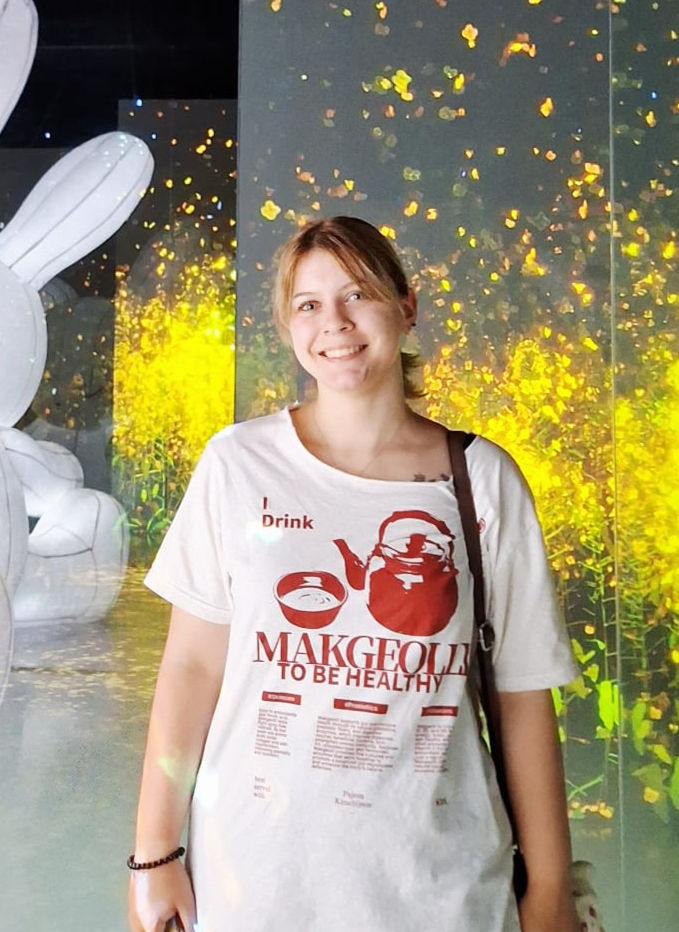
Christina
University of Florida
"I've always been heavily invested in K-Pop. I love to travel and I thought it would be a really cool opportunity to get to come all the way across the world to study. I really loved the whole process getting to do everything with Hop. Everything was taken care of so well."

Dieunise
University of Florida
"I was able to see how different parts of the world live in different ways. It opens your eyes to so many different perspectives of what it means to live as a human. Step out of your comfort zone. You need to study abroad!"


making it happen
Seoul, South Korea
Summer: Jun 25 – Jul 24, 2027
Summer: Jun 25 – Aug 6, 2027
starting at
$XXXXX
inclusions
Summer tuition
Twin-share furnished accommodations
Hop exclusive local day excursions
Airport reception and pickup
Buddy Program with local Korean students
Hop Orientation
24/7 Hop support and your Hop Go-To (other programs say Resident Director)
Pre-departure advising to get you ready
International airfare not included


why study abroad with Hop?
Because we do study abroad differently. We’re all about creating a community that’s as diverse, adventurous, and curious as you are. Our programs are anything but cookie-cutter.
unique & innovative experiences
Our programs offers one-of-a-kind experiences tailored to various interests—whether you're diving into Korean culture in Seoul, competing on Scholar Island in Fiji, exploring the world Down Under in Australia, experiencing the beating heart of Europe, or innovating with startups in Thailand.
a focus on you
Studying abroad is all about you—and we’re here to make sure you feel supported every step of the way. From our mindfulness-focused Well-Come Abroad orientation program to our dedicated on-the-ground support staff, we ensure you gain invaluable international experience, develop new skills, and boost your resume—all while having the time of your life and prioritizing your health and well-being.
global connections
Join a community of like-minded peers from around the world while building relationships with locals, professionals, and professors who can inspire your academic and career journey.
why study abroad with Hop this summer?
Summer with Hop isn’t just about academics—it’s about creating unforgettable memories, challenging yourself, and returning home with stories that will stay with you forever.
unique & innovative experiences
Our programs offers one-of-a-kind summer experiences tailored to various interests—whether you're diving into Korean culture in Seoul, competing on Scholar Island in Fiji, experiencing the beating heart of Europe, or innovating with startups in Thailand.
short yet impactful
Summer is the perfect time for a focused, immersive program. In just a few weeks, you can gain international experience, learn new skills, and build your resume without interrupting your academic year.
global connections
Join a community of like-minded peers from around the world while building relationships with locals, professionals, and professors who can inspire your academic and career journey.


We acknowledge the Traditional Owners of the lands upon which our students are welcomed, recognizing that our experiences are held on their ancestral territories. We deeply respect and honor the enduring cultures and significant contributions of all First Peoples, past, present, and emerging.